
Single-Card Tarot Reading with the Book of Thoth Deck (or Serial Card Pull)
Difficulty: Easiest
The one card tarot reading is best for times when focusing on just one thing without any potential complications is desirable. It can be used for just about any question, including to draw a card of the day, week, or even one's card of ultimate destiny. It can also be used repetitively, as some readers prefer to pull one card at a time, watching as a story unfolds. There are even some readers who don't use tarot spreads at all, relying on this method alone.
Your One Card or Serial Draw Stack
Draw #1 — Ace of Cups
Ace of Cups
The Root of Water
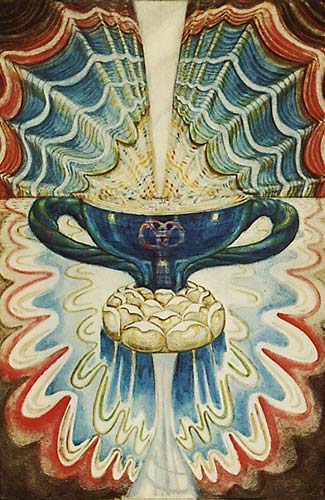
This card represents the element of Water in its most secret and original form. It is the feminine complement of the Ace of Wands, and is derived from the Yoni and the Moon exactly as that is from the Lingam and the Sun. The third in the Hierarchy. This accordingly represents the essential form of the Holy Grail. Upon the dark sea of Binah, the Great Mother, are Lotuses, two in one, which fill the cup with the Life-fluid, symbolically represented either as Water, as Blood, or as Wine, according to the selected purpose of the symbolism.
Above the Cup, descending upon it, is the Dove of the Holy Ghost, thus consecrating the element. At the base of the Cup is the Moon, for it is the virtue of this card to conceive and to produce the second form of its Nature.
This card represents the element of Water in its most secret and original form. It is the feminine complement of the Ace of Wands, and is derived from the Yoni and the Moon exactly as that is from the Lingam and the Sun. The third in the Hierarchy. This accordingly represents the essential form of the Holy Grail. Upon the dark sea of Binah, the Great Mother, are Lotuses, two in one, which fill the cup with the Life-fluid, symbolically represented either as Water, as Blood, or as Wine, according to the selected purpose of the symbolism.
Above the Cup, descending upon it, is the Dove of the Holy Ghost, thus consecrating the element. At the base of the Cup is the Moon, for it is the virtue of this card to conceive and to produce the second form of its Nature.